To live is to change, to acquire the words of a story.
--Barbara Kingsolover, The Poisonwood Bible

Monday, January 27, 2014

Gramps

In our interview for Peace Corps back in 2010, we were asked if there was any reason we would choose not to do Peace Corps. Pat and I looked at each other and both said, "Grandparents."

With our grandparents all at a somewhat advanced age, we knew it was possible that we wouldn't make it through our two plus years without having to say a long-distance goodbye. When I said goodbye in March 2012, I sobbed on the drive home from my grandparents' house. But then we visited home and all was well, the goodbye wasn't as hard. It was only seven months.

My grandpa died yesterday. At 91 and suffering from congestive heart failure and moderate dementia, he fell and broke his leg. He had surgery and never fully woke up from it. The memorial service will be on Saturday, and even though we will do another celebration of life this summer, missing this service may be the hardest part of Peace Corps. My mom asked me to write something that could be read at the service, so this blog post is a bit of a draft for that and a lot of my mourning poured into words on a screen.

The other night, when it was becoming clear that the end was imminent, I was journaling as I prayed, and I caught myself trying to pray that this wouldn't be the end, that I would be able to see him one more time. Then I realized how selfish that was to hope that the end of his life would be dragged out simply so that I could be there. Beyond the standard peace and comfort, I grappled with what to pray for. It came to me to pray to be flooded with the good memories, the little things that made up the essence of Gramps. Here's the highlights:

My very first memory is of holding his hand. His and Grammy's, and trying to swing myself as we approached the hospital to meet my baby sister.

He had open heart surgery the same year I was born, and he always had to take a lot of naps. I loved tucking him in on the floor. Every single time, he would wake up and say, "Boooooy did I sleep!"

I wanted to be just like him in a lot of ways as a kid. Mostly I wanted to be a cowgirl, but when that didn't work out due to my sister's extreme horse allergies, I settled for trying to find a walking stick that he would approve of on every hike we took around the cabin that he bought in the 50's, the place I still claim to be my favorite on Earth.

When making phone calls from Bozeman to Livingston (the town twenty minutes away he and my grandma lived in for the past sixty years) changed from costing a long-distance rate, I became the happiest nine year old in the world. I would take the bus home from school every day, pour myself a bowl of Cheerios, and call my patient, patient grandparents, who would listen to the day's joys and tribulations as I slurpily recounted them.

In second grade, my class had an Africa day. I was so excited, because Gramps had been to Kenya and Egypt in the 70s. Somehow it got worked out for him to be a guest speaker, and I was so proud. And look at where I'm writing this from. Coincidence? I think not. I first started travelling thanks to a yearly spring break trip we took with them from the time I was in first grade until my sophomore year of high school. Thanks to his travel bug, I got bit early and hard.

He had very strict rules for making lefse, loved lutefisk, and hated Prairie Home Companion because "they make fun of Norwegians". 

When all of the valuable Molesworth furniture that came with the purchase of the cabin was stolen out of it, he started experimenting with how to replace it and came up with "Roaldsworth". His furniture was so beautiful. I liked to sit in his shop and watch him work and then claim to have helped.

I would sit on his lap after I was far too big for it to be comfortable for him, but he never said a word. 

He thought that our spaniel Lizzy was small and useless until she chased away a mountain lion that was sitting on its haunches watching my mom and uncle outside the cabin. After that he called her "Lionheart" and would permit her to spend the night in his workshop when we came over.

He was incredibly proud of his North Dakotan roots, a pride that grew with the Bakken Boom. "And they said North Dakota would never amount to anything," he muttered once.

He went through a bread making phase and would make what came to be known just as "Gramps' bread", which had no nutritional value but was my favorite food for several years. When my mom followed his steps and got a bread machine, I was not as enthused about her whole grain copy-cat bread.

I loved the story of how he and Grammy met, how she had a crush on him and would spread out her shopping at the pharmacy where he worked, buying one item at a time to increase her outings to the store. Gramps wanted the night off to go to a basketball game, but his boss would only let him, “If he took that blonde that keeps coming in here.” The image that will always stay with me now is of her holding onto his two fingers as they slowly made their way about.

He was infuriatingly slow at opening Christmas presents. He would take a knife and slide it gently down each piece of tape as we all would watch in indignation as the clocked ticked by and we had to wait an extra two minutes for our turn.

As a kid, I was very upset about the idea of smoking (as in, I was so upset that I would cry about billboards advertising cigarettes). I idealized Gramps to the point that when I learned that he used to smoke, I converted into a story in my head about how he’d been tricked and quit long before he actually did. I believed my version of this story until probably college.

 Some of my favorite childhood Christmas presents were the ark he made, complete with many species of wooden animals and the stable for my toy horses.

They say that he was a crier, but I only saw him cry once, and I don’t even remember what it was about. I definitely inherited that trait though. Yesterday, my mom put the phone to his ear so that I could say goodbye. Even if he was conscious, he probably wouldn't have understood what I was saying--thanking him for being the grandest of Grandpa's, for always making me feel so loved, telling him how much I would miss him. I cried so hard that my neighbor Kountimba, who is mostly deaf, came over to see what was wrong. People have a hard time grasping the idea that in America medicine is so advance that you can be pretty dang sure that it is the end of life. I'd been through this before, so I decided to tell just tell her that my grandfather had died. She put her wrapskirt up to her face and started to do a high pitched shriek, the death wail. This made me cry all over again, and she stopped to hush me. The whole exchange meant a lot, but I needed to just grieve in my own culture, one where I was allowed to cry. Pat sensed this and dealt gracefully with the growing crowd of neighbors as I retreated inside to contemplate having said goodbye.

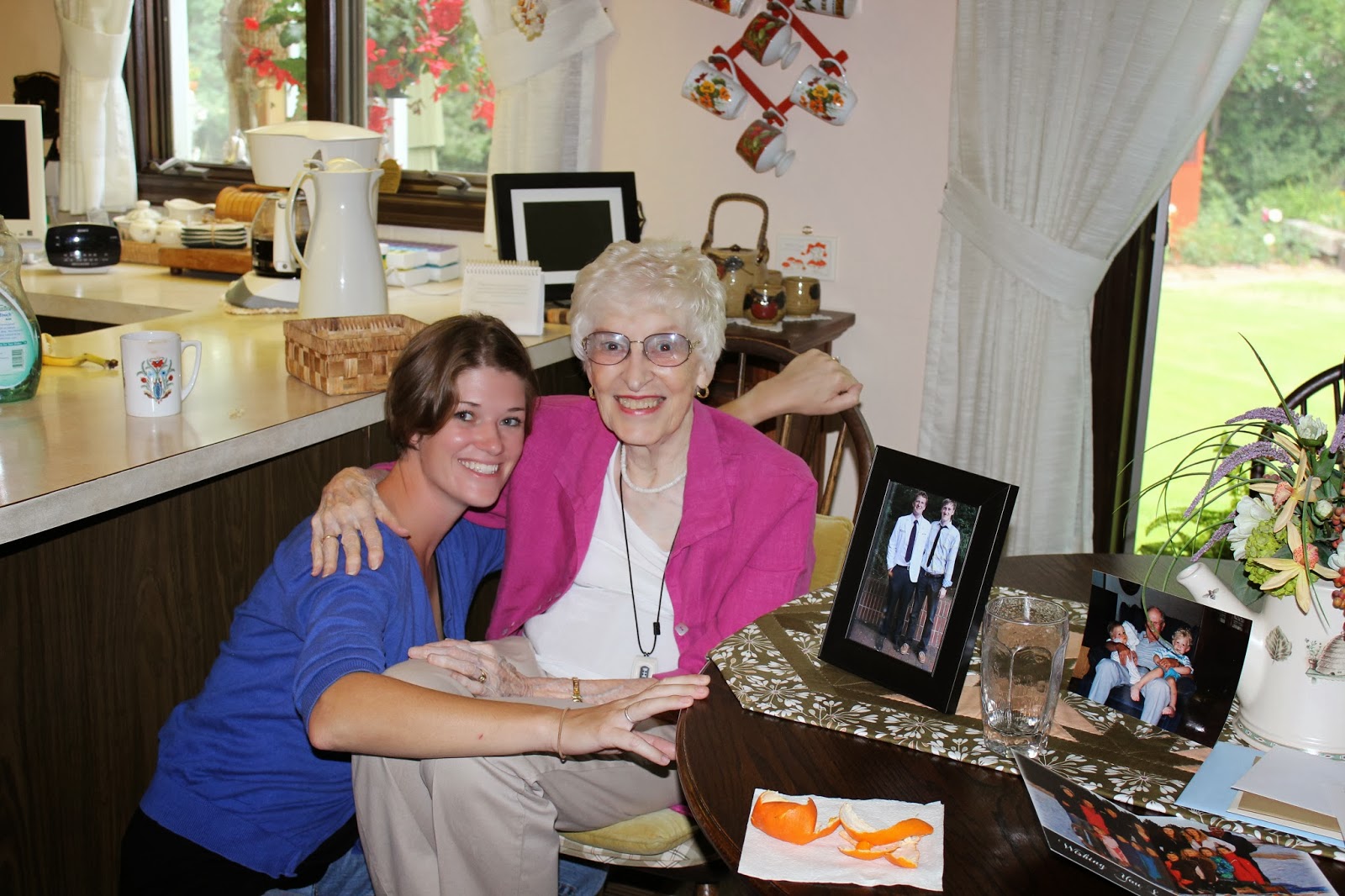
Goodbye Roald Jasper Mogen.  You taught me so much about gentleness, steadfastness, generosity and love. Now you are teaching me about loss.


Most of my cousins and some significant others at Gramps' 91st birthday party last August. I'm so grateful to have been there. I'm the oldest grandchild, which, in my humble opinion, makes for an extra-special grandparental relationship.
Pat and I with Grammy and Gramps in probably 2008. He was a North Dakotan rancher, a small town Montana pharmacist, a father of three, a grandfather of six, an adventurer, and a stubborn Norwegian.

Grammy and Gramps at their 60th wedding anniversary dinner. They are not smoking cigars. Just holding fancy cookies.

Pat and I got married exactly sixty years after they did. Here's my cousin Colin escorting them to their seats at our wedding.


Gramps made it to the airport to welcome us home last August. He rarely left Livingston at that point. He never ceased to make me feel special.


Thursday, January 9, 2014

Bending it Like Eto'o

Just over a year ago, the eight volunteers in the department of Saraya were sitting on the floor of our hut (it’s a good thing we have a giant hut—it doubles as a work zone office) going around and sharing about what we had been working on and our ideas for future projects. It was there that Marielle, who had just moved to our site to finish out her service, first got the ball rolling (pun intended). “I’d like to start a girls’ soccer team.”

Marielle is a great runner, and some of the kids in her compound had been tagging along on her runs (which is impressive…I never even tried to keep up with her). She also had been given some practice jerseys and a few balls. It was one of the moments in my service that I remember feeling giddy about an upcoming experience. I knew that I was going to love this. I wanted in.

The first challenge was finding a time to play. Girls are expected to help out at home with the never-ending chores: pounding grain, cooking, cleaning, laundry. Everything has to be done by hand and thus takes forever. Organized play is not something that they or their moms are used to, so it was tricky. Fortunately, we started during cold season, so playing in the afternoon was bearable. But they were always coming over to look at our watches and would throw off their jerseys and run home in the middle of the game if it got too late, and the average age of the girls who play has decreased with time.

Marielle finished her service last April, and, along with some of her projects, I inherited the head coach position. It was hot season then, so we couldn’t play in the afternoons any more. At the time, the water crisis was in full swing, and there was no water on Sunday mornings. Since girls couldn’t carry water those mornings, we chose that time to play and made it an official weekly thing. That worked, but then things got really busy for me when rainy season came and my malaria project started up. And they stayed busy, so I haven’t been able to keep soccer a regular thing. Every time I pass a group of girls, they’ll yell, “Sadio, when are we going to zouer?” (The French word for play is “jouer”, but the little girls can’t make that sound so it comes out as a z and is super cute.) I squeeze in games whenever I can—the girls love it, and it really helps me to feel present in the community.  The majority of my work has been in the villages surrounding my site, so it’s nice to do something here. I’ll tell the girls that we’ll play in the evening, and by mid-afternoon, a group has started lurking around the entrance to my hut.

It’s not always easy though. Once you get the girls to the field, the second challenge is to keep the boys away. They apparently have a sixth sense for knowing where a soccer game is happening, because wherever we play, they always show up and disrupt things, coming on the field and demanding to play. There are some that just can’t handle watching girls get to play a game with the toubabs. (The constant shortage of soccer balls does not help this. It is not infrequent that we have guests who come to see us just to ask to borrow a soccer ball. We stopped lending them out because they would always get destroyed or never come back.) Sometimes boys can be helpful and ref or explain more difficult soccer rules in Malinke, but sometimes I have to put on my threatening face and chase them away. They recently built a wall around the school, and the girls locked the gate from the inside when we were playing yesterday. All of a sudden I looked up to see boys scaling the wall not unlike the zombies in the Israel scene from World War Z. One day, we were walking from my hut to the school with the ball and jerseys and ran into the Inspector of Youth (real title). “Sadio, you are training the young girls! I should have been informed about this!”  Everyone wants in.
 
Playing with the girls is usually a blast, but it always makes me reflect hard on the differences between my own childhood soccer days and what these girls have to work with. Think of an AYSO soccer scene. Take away the grass and replace it with dirt and trash. Take away the cleats and replace them with one jelly shoe (two girls will share a pair). Take away the goals and replace them with some sticks. Take away the soccer shorts and replace them with wrap skirts that are so difficult to run in they often get ripped off and thrown on the ground. But the thing is, the kids are the same. There are the ones that are clearly natural athletes at the age of 6. There are the ones that sit down in the middle of the field and play with something they found as the game passes them by. They are more concerned with what color jersey they get and how it fits than any other aspect of the game. Herd-ball is definitely a thing. Depending on the day, either everyone or no one wants to be the goalie. And, despite conditions that would shock the average American youth soccer team, I am willing to bet they have just as much fun.


Coaching this team, however, has proved to be as challenging as it is fun. Since they have never encountered any other forum for learning sportsmanship, fights break out at a rate that continually shocks me. Having a large age range doesn’t help much, and siblings aren’t very graceful towards each other. I have had to scream my head off to break up fights…not the image I had of myself as a Peace Corps volunteer. I have decided that I won’t let them get away with acting like terrors, and I have stopped a game soon after it started.

In the end, though, all of my frustrations are trumped by the beautiful moments. Yesterday, for example, Kany showed up late but with a bag in her hand. Everyone stopped. They knew what was in the bag. Her dad had bought her lace-up shoes for playing soccer. She put them on the ground and looked at them for a second. Samouro piped up, “Sadio sits down when she puts on her shoes like that.” Kany proceeded to put on the shoes and then tie funny knots around her ankles. She was ready to play.


Saturday, November 9, 2013

The Rihannas of Seasonal Malaria Chemoprophylaxis

"Sadio, you tricked me!" my host sister Diabou announced as she approached me with both narrowed eyes and a smile.

"What?"

"You didn't tell me that my picture was going to be everywhere!  Everywhere I go people are telling me that my children and I are on their pamphlets.  Even in the village where I grew up!  Even in Sanela!"

"I did too tell you that!  When my friend who speaks Pulaar came with her fancy camera, I explained that I had been asked by people in Dakar to take pictures to help with their malaria prevention campaign. I told you that the pictures would be all over Senegal."

"Well I forgot.  And you said about the poster, but I or really understand that every person was going to see it.  People from Kondokhou  and even Sanela have told me that they saw my picture. I would have tied my headscarf better and made myself pretty."

"Diabou, you look beautiful in the pictures.  And you look like a good mom because it shows you giving your kids the medicines to prevent malaria.  Be excited!  You just became a celebrity!"

"A what?"

"Basically, you're Rihanna."  With that, the narrowed eyes disappeared, and she ducked, laughing, back into the cooking hut.
*******************************************************************************
In May I had the fortunate to be asked to attend a workshop with the National Malaria Control Program and other partners to plan for the roll out of a Seasonal Malaria Chemoprophylaxis (SMC) program in the 4 regions of Senegal where malaria is the most prevalent.  I learned an amazing amount participating in this national planning process, and this month, I finally got to see the intermediate and final planning steps as well as the actual launch of the program.  I supervised the training of the community health workers in one health post and then supervised the implementation in several villages.  Seeing a project from start to finish was really interesting, and I think will be extremely valuable in future global health work endeavors.

SMC distribution in action
Yummm Amodiaquine!
SMC is the administration of preventive medicine for malaria in areas where malaria has seasonal peaks during the months of those peaks.  The World Health Organization estimates that SMC can reduce the incidence of malaria within the target age group by 75%. Community health workers go house to house to administer the first dose of the medicine to all children under ten.  The mother is instructed how to give the necessary doses for the second and third day. The medicines protect the child for one month, after which the cycle was repeated.  This was supposed to roll out in July, but due to problems with the medication  manufacturing, it had to be delayed until November.

Maybe it was the delay that made Diabou forget about the pictures.  At the national meeting, I was on the communications committee, and I was commissioned to take a series of photos to be used for the campaign, since I actually live in the setting where the program is taking place and apparently could more easily capture the village scene.  We needed photos for a poster and for a reminder booklet for the health workers who would be implementing the distribution.  I asked my friend Ashleigh who had a sweet camera and takes great pictures to come help.  She recently left us for Amerik and then Cameroon, so I'm grateful to have had the photo shoot adventure.

There is a community health worker who lives with my host family, so he got to play the part of the health worker.  He even changed into his World Malaria Day t-shirt for the occasion.I didn't give Diabou much advance notice of the exact timing of the shoot precisely because I didn't want her to go put on a bunch of makeup and become a scary clown (as she tends to do for holidays)--they wanted a realistic scene.  

Let's be honest.  The primary goal of this blog post is to showcase the modelling talent of my host family.  They are basically Rhianna.


There they are! SMC Campaign poster at the Saraya Health Center.  Slogan: Let's protect our children from malaria.

Brochure to be left with each mother to explain the campaign and how to administer the meds, and the guide for the health worker

Dosage differs by age group, so photos of Mamadou, Oumou, and Sambaly served as reminders of what children of the different age groups look like--people rarely know exactly how old their kids are. 

We took headshots of all the kids that were around that day. They didn't all make the cut since there are just three different age groups, but the photos are so great that I wanted to post them here anyway. Here's Kounadi. 

Samouro is thrilled to see her face all over town on the poster and pamphlets.
Kharifa!

Step by step guide: Identify the children under 10, get clean water, make sure the child has eaten, crush the pill for kids who can't chew, leave the meds for days 2 and 3 with the mother, mother administers remaining meds

More step by step guidance.

This is my favorite picture that was taken that day.  The English translation of Toumany's shirt is: Defeat malaria.  SMC is definitely a tool that can lead to the eventual accomplishment of that goal, and it has been exciting to be a part of it.


Monday, October 28, 2013

October 2013: Month of Specula and Cervices

It’s been looming since the beginning of my involvement with the peacecare project.  Prevalence study.  A massive, yet exciting undertaking.

Peacecare, which pairs Peace Corps Volunteers with academic medical centers in the states (thus the semi-confusing name) has been working in the Kedougou region for the last few years to build a comprehensive cervical cancer prevention program.  They have trained midwives and nurses to screen for pre-cancerous lesions of the cervix using VIA (Visual inspection with Acetic Acid) and brought Cryotherapy equipment to Kedougou in order to treat any lesions that are found during screenings.  They have trained a small team of midwives to themselves continue to train others in VIA and have started to work with the region on developing a policy for cervical cancer prevention.

To gain support for the program at the national level, it was decided early on to conduct a prevalence study of cervical cancer and dysplasia throughout the region in order to demonstrate the magnitude of the issue.  Doctors and the states and here in Senegal decided together on a methodology of a randomized cluster study where mass screenings would be conducted in randomly selected villages.  In order to get a sample size that could be representative of the entire region, 40 villages were randomly selected, with a total of 738 women aged 30 to 50 targeted to screen throughout.

To be able to screen that many women, more midwives and nurses needed to be trained to perform the screening method.   At the beginning of this month, we worked with the midwife trainers to train every female practitioner in the region, to give a refresher course to those who had been trained by peacecare in years past, and to provide an orientation to cervical cancer prevention and the study to all the male nurses stationed in health posts whose villages had been selected for the study.  It was an intense seven days of back to back trainings, but I was blown away by the quality of the midwife trainers and the impact that training of trainers programs can have.

 At the training, we worked together to figure out what was feasible to accomplish on the study during the peacecare team visit during the last two weeks of the month.  Because of the visit’s proximity to Tabaski, the biggest Senegalese holiday, mass screenings had to be limited to the last five days of the team’s time in Kedougou.  Each post took one or two days for screenings, and the district team committed to organizing outings to the selected villages.  When the peacecare team came, they spent a few days in Saraya and then split up to go to accompany midwives in each of the three health districts in the region.

Of course, there were many things that went wrong, but development work is all about finding solutions.  In the Saraya district, we conducted screenings in 8 villages in 5 days, screening 96 women in the target age range, and finding 6 women with precancerous lesions that were referred on to Kedougou for treatment.  That puts the prevalence of dysplasia at about 6% at this point in the study.  It was exhausting, but a great start to a study that will provide results that will be very important in the realm of women’s health in Senegal.

The following is a piece that I wrote for peacecare’s trip blog.  The blog, with contributions from other volunteers involved in the project and the doctor, residents and med student that came on the trip can be found at: http://uicgch.blogspot.com/?view=classic   
  
In the brief moments of calm that surface here in there amongst the madness of the prevalence study, we have snuck in conversations regarding the strategic planning for peacecare’s work in Senegal and the role of Peace Corps volunteers in these different strategic advancements.  My contributions to these questions have come to be based off of the following thought:

No matter what specific role we have, the greatest contribution that I have made as a Peace Corps Volunteer to the peacecare model is the relationships I have with our Senegalese counterparts and the communities within the Saraya Health District.  This has become especially apparent to me throughout the last month as we prepared for the prevalence study by either training or refreshing every midwife in the region on the IVA visual screening technique, and then in the launch of the prevalence study itself.

My fellow volunteer Chip pointed out in a previous blog post from this trip that much of the project planning in Senegal takes place at the last minute.  I would actually take it a step further and say that a lot of the planning and logistics takes place after the last minute, when you should have left for the mass screening already and you realize all the things that are still left to fix.  These are the moments where, without relationships to fall back on to find solutions, some things just could not happen.

When we arrived in Saraya with the peacecare team to find the cellphone network out across the entire department, I knew I was going to have to utilize both my legs and the rapport I have built over the past year and a half to get things rolling. When organizing teams of midwives for the mass screenings, we had to go to their houses to confirm their readiness for the next day’s outing.  An NGO that comes in with no knowledge of the local partners and where they live couldn’t do that.

When we couldn’t call the community health workers in the outlying villages to let them know we were coming, we had to rely on our partnership with the community local radio station.  Fortunately, this partnership is so strong that I have the ability to go and interrupt almost any DJ’s show in order to announce the next day’s outing to the health workers and women of the village.  (The strength of this relationship can also be exemplified through the fact that , on the radio station’s sixth birthday party last month, the Peace Corps Volunteers were presented with the liver of the cow slaughtered for the event.  My husband Patrick said that when he brought the liver to Kedougou the next day to share with the other volunteers, no one in the car batted an eyelash at the giant organ he was holding in his lap.)  In addition to my frequent interruptions of radio programming, I would send messages with people I knew from these villages who happened to shop up in Saraya.  I have spent a great deal of time traveling and working in the small villages surrounding Saraya, and it paid off to know who could get the word out. 

The mornings of outings, I had to rely on my knowledge of who could be sweet talked into loaning us their roll of cotton or box of gloves so that we could leave at a somewhat early time (“We’ll pay for it later, we just really need the gloves right now!”) Understanding the goals, motivations, and limits of different individuals got us going, even when people we were counting on to organize things were sick or called away.

Some relationships are earned, and some are gifted by quirks of the Malinke culture.  Upon arriving in Saraya last May, I was given the name Sadio Tigana.  My host mom is my namesake, and the namesake bond is strong—strong enough that we are in many ways considered to be the same person. For example, her children call me mom.  At one of our mass screenings, I was able to overcome the reluctance of my host mom’s adult daughter to get screened not by explaining the benefits of screening but by telling her “I am your mother, and you must do this for your health.”
The relational aspect of peacecare’s work is one of the things I appreciate most about the model.  In my view, the friendships formed and sustained through the biannual visits and the partnership with Peace Corps Volunteers have done as much to advance cervical cancer prevention in this region as the technical training.


Playing with the babies of midwives isn't necessarily work, but those relationships go a long way.


Elodie, a nurse and one of my best friends in Saraya practices the visual screening method during the training.

Identifying whether a cervix has a precancerous lesion or another pathology.

Two midwives do a roleplay of the counseling involved with cervical cancer screening.

Certified in the theory of Visual Inspection with Acetic Acid.  Now all that's left is the practicum, which midwives were able to complete during the launch of the prevalence study.


Andrew and Michael get a chance to try eating with their hands as we share lunch with a community health worker in one of the villages selected for the study.
P.S. Included in the many things I learned this month are the plural forms of the words speculum and cervix.

Monday, October 14, 2013

Taking it Personally

It had already been a memorable day when we rolled into the health center that evening.  Memorable in both a bad and good way.  Our car had broken down about halfway into our voyage into the deep bush to conduct malaria testing sweeps of five villages that are serving as comparison sites for our active early diagnosis and treatment project.  The project had reached its midpoint, and we needed to see whether the proportion of the population with symptomatic malaria was any different at that point than in the project villages. 

After some hot and frustrating spent time waiting on the road, we finagled some creative hitch hiking and successfully made it to four of the five villages.  In the village where I went, the health worker treated 26 people for simple malaria.  The meds are very effective and given for free by the government, and I love accompanying health care workers as they sweep the village looking for anyone with symptoms, administering rapid diagnostic tests, and treating positive cases on the spot.

The car still wouldn’t start when we made it back to the breakdown site that evening, and the hospital had to send an ambulance to pick us up.  On the ride home, my exhaustion started manifesting itself in random giggles, and I announced I had the tired jollies.  But as we rolled into the health center, I was concerned by what I saw. Two of my neighbors were standing next to the night guard. Siriman, the patriarch of the family we refer to as our second host family, had had a stroke several years ago and rarely leaves home at night—he wasn’t there just to hang out with the guard.

I jumped out of the car and went over to them. “Bebe is sick,” Moussa told me, his face somber, a contrast with the sly grin he usually exhibits. I had last seen Koumba, the four year old girl they referred to as Bebe, a few days before at a neighborhood gathering to prepare a big meal for our soccer team as they got ready to face their cross-town rivals.  She had been lethargic and wouldn’t even smile at me, a rarity. I had told her mom Oumou to take her to the health center—this time of year, any time a kid isn’t acting normal, it’s safe to assume they have malaria.

I started to head to the other side of the health center where the hospitalized patients were, but Moussa grabbed my arm and pointed me in a different direction. The motorcycle storage shed had been converted to an overflow area with two beds. I saw her lying in one, flanked by her father, and her namesake, grandmother Koumba. As I approached, I could hear her labored breathing before I even saw her up close, hooked up to an IV, her small body heaving with each breath. “Thank God they finally brought her in,” I thought.     

“Dobotala?” I managed to squeak.  This is the standard thing to ask any Malinke who is sick or injured. It literally means, “Did some come out of it?” the it referring to the sickness. The standard answer is to say that yes, some came out of it, no matter whether you are actually feeling better or not. But this time, the elder Koumba just said, “We are here.”

I sat with them for a bit longer on a dusty bench before getting up to take care of some things from the day’s outing, assuring them I’d be right back. They were stupid things like paying for the gas and driver for the ambulance that had picked us up. Nothing that couldn’t wait. I was so naïve. Even after having seen two small bodies carried out of that place that week, I didn’t know.

I came back ten minutes later, having gotten distracted telling stories of another day full of adventure in the bush to the nurse from that area, who loved hearing about us getting wildly lost and caught in a rainstorm. Pat’s posture and red eyes gave it away before anything else.

“Did she die?” I asked. As I heard my own voice, I was incredulous at how flat it sounded. This was just not any child, but someone dear to us, someone we had thought of when we chose presents to bring back from the US, someone who was a presence in our daily lives. But that’s shock, I guess. This was the day I had been terrified of for my entire service.

Pat’s eyes flooded.  He had taken my place on the bench, watched her father Omar tell her “dondin, dondin” as she continued to struggle to breathe. Little by little. Then her breath stopped and her eyes rolled back. Omar had sighed with relief; he thought she had finally relaxed. Pat had to tell him that his little girl had died.

I couldn’t do anything but repeat, “I just can’t believe it.” In English, in a whisper, as my own tears started to fall. We had spent the day getting meds to people in villages that are nearly impossible to get to, and now this had happened to a family who lives a five minute walk away from the health center.

“Stop crying, you two,” Siriman admonished in our direction. To Pat, he added, “Ibrahima, there are women present.” We couldn’t stop. “It is God who gives life, and God who takes it away. What can you do?”

I have heard the wail several times before, the signal of death echoed by women across the town. But I have never heard the original wail, the first sound of a mother’s grief. I couldn’t see Oumou as she howled, but the sounds of grief were distinct enough to create a mental picture that will continue to haunt me. The sound simultaneously evoked several emotions. Guilt. How could I have possibly walked away in her last moments? Deep sorrow. There can be nothing worse than losing a child. Raw rage. Why the hell did they wait so long? Indignation. How can we live in a world where the 50 cent cost of a consultation can be too big of a barrier to access  care?

I’ve watched so many kids get malaria over the past two rainy seasons. I have yelled at my host family for delaying in taking kids to the health center. But the kids I know have always been fine in the end, to the point where I had started to wonder whether I had been overreacting. 660,000 children die from malaria every year, approximately one every minute. That minute it was in Saraya, and Bebe turned a horrifying statistic into a horrifying personal reality.

 Much of my Peace Corps service has been dedicated to fighting malaria, particularly in getting early treatment to those who contract the disease, despite the arsenal of prevention efforts. Back in August, the director of Peace Corps Senegal came to visit us in Saraya and accompanied me supervising an active sweep of a village. He talked about how important the project is, how it can serve as a model in preventing child deaths across the continent, showing that it’s possible to play offense instead of defense. When he talked about the project’s importance, I was gladdened to realize that there was nothing I would change about the way we were implementing the project or the work I was putting into it.  I had been giving it my all to this fight against malaria, without knowing who was watching.

But the fight became personal that night. I am taking malaria personally, and the gloves are off. I am channeling my sorrow and rage into this work. Because, Siriman, that is what I can do.


Bebe, second from right, with a present brought to her by my friend Kara on her visit last November.


Friday, October 4, 2013

There and Back Again


If you look through my journal, the majority of my entries start with an excuse about the reason that I have gone such a long time without writing.  It apparently has become the same thing with my blog.  The thing is, I have so much to write about from the past three months, and it’s been hard to know where to start.  The PECADOM Plus malaria project scale-up was launched in July, and so much happened during the five days of the project launch (which may well end up being the most important five days of my service) that I spent about 6 weeks journaling about all of the crazy incidents that could have blown everything but miraculously didn’t.  I didn’t want to forget a thing, but I knew it would be too much detail to blog about.  Even with all that time journaling, I didn’t even get to day 4.  There will be a blog post about it all and what came after, but not this one…at this point, I might as well wait for some results, and we just completed the midline evaluation of the project, comparing the 15 project villages with the 12 comparison villages that we could get to during the height of rainy season, so midline results are coming soon.

Right after the project launch, our dear friends Marija and Michael Crosson came to visit, and I am hoping that there will soon be a post written from their perspective of the wonderful time we shared in Kedougou (hint, hint, you two). After their visit, it was only a matter of making it through Ramadan before we were to embark on a journey to a strange land: America. 

Picking the dates for this trip home was a tricky business.  We had to go home early enough to be able to spend time with my sister Jill, who started a teaching job in Wyoming, and late enough to be attend two very important weddings, one where I was an usher and another where I was a bridesmaid.  There were birthdays and family reunions, and, of course, the fact that we were trying to schedule all of this in the middle of the implementation of the malaria project.  The project entails low level community health workers doing sweeps of their village each Monday to test for and treat simple malaria, so we arranged the trip to miss as few Mondays as possible in order to maximize our potential for supervision of villages throughout the five month project.  Fortunately, our good friend and close neighbor, Karin, has been highly involved with the project since its beginnings on a smaller scale in our friend Ian’s area last year, and she took over the coordination, no problem.

Because I have thoughtful and inquisitive friends and family, I was put in a place of reflection about my time in Senegal and at home almost constantly during our time in the states.  The airport in New York brought several surprises.  I was amazed by the diversity surrounding us as we waited for our bags in order to go through customs and then equally amazed by instinct to carry my huge duffel bag on my head.  We were blown away by prices and found ourselves converting dollars into West African Francs (this beer is 5 mil???) 

Our first real meal was during our strategically planned overnight layover in Minneapolis.  Kara picked us up at the airport and drove us to a dive bar that was filled with familiar faces and featured the Juicy Lucy, a hamburger where the meat is infused with cheese.  We had heard of this Minneapolis delicacy in the food-fantasy –filled weeks leading up to the trip and made the request.  It was delicious, and I have no regrets, even though my I later learned that my stomach had basically forgotten how to process meat, and Pat and I spent most of the night alternating turns in the bathroom.  It should be noted here that on the way to the airport in Dakar, our country director, who kindly dropped us off, warned us that, once stateside, we should not talk about our intestinal issues in polite company.  That first night made the warning difficult to adhere to.

Often throughout our time at home, people asked me if it was weird to be back.   I had fully expected it to be, but I guess a year and a half in West Africa, no matter how significant, can’t erase 18 years in one house in Montana.  It was shockingly easy to slip back into such a comfortable way of living.  I did appreciate every single hot shower, however.

I know it will be hard when we make the real transition back to America in just over six months.  But for this visit home, we were able to just focus on seeing people we loved, being in the mountains, eating delicious and nutritious food, and enjoying the general glory of America.
I know that a lot of people who read this blog were people I saw when back home, so I’ll stop with the reflections here and just let the pictures (and captions, I guess) do the talking.
I left my site on the evening of Korite, the second biggest holiday (notice my fancy outfit).  This was not the plan, but since the lunar calendar is not exact, it's the way things worked out.  It turned out that it was next to impossible to get a car to the regional capital, and another volunteer and I had to throw down to pay for a police car to take us.
The voyage took four days from our home in Senegal to our home in America, but with such a welcome crew, who can complain?
Family pictures at my Grandpa's 91st birthday party--I've got some stellar cousins..
Grammy!  We'll be back just in time for her 90th birthday next May.


My sister was able to come up for a few days before starting her teaching job, and her boyfriend Bret was able to join us for the weekend.  So good to be all together.


The familia at our cabin, one of my favorite spots in the world.

Hiking with Mama.
Lava Lake with Emily.

Pat's Mom's family had a family reunion on Hebgen Lake.  Somehow I grew up an hour and a half away and have never been there.  This photo is the fifth or so in a series where I can't seem to keep my eyes open, so it's that I'm really surprised here.

Natusi, Emily's dog, gets a good view of the lake.


The moutain mornings were so cold!  It was so fun to be able to bundle up!

We drove through Yellowstone on our way back home from the reunion.

Wearing shorts and showing my knees in public really took some getting used to.

Hot potting in the boiling river!

Demonstrating the skills I have learned in Africa.

First of two wedding weekends.  Back to Minneapolis for my college roommate Kara's wedding.  Weddings are the best.  So many good people in one place to celebrate love.


One of the highlights of my trip home: surprise rendition of Toto's Africa just after Kara and Dan were pronounced husband and wife.  Rachel Reckin is a rockstar for pulling this off.
Wedding weekend number two!  This time we drove to Tacoma for another reunion with some of the best people around.  

So honored to be a bridesmaid in Kerri and Jame's wedding.  Kerri is one of my dearest friends from PLU.  You know you've been gone for a long time when your friends get engaged to people you haven't met yet!  Fortunately, I approve in a big way.
There were so many good times I didn't get pictures of.  A whirlwind trip back to Missoula, where every hour was booked with a date to catch up with someone fantastic and we realized that we felt just as home there as in the Gallatin Valley.  Game night with my mom's friends, whom I have adopted as my own.  So many good meals.  A 30th birthday party.  A pedicure when I still had henna on my feet, and my pedicurist didn't have a clue what to do with me and basically rubbed the tops of my toes raw, laughing all the way.  We were exhausted from our efforts to try to spend good time with as many people as possible, but we didn't come home to rest.  We knew what would rejuvenate us, and it did.  Thank you to everyone who was a part of that rejuvenation.

When we got back to our hut, this jungle of a yard awaited us--this had been dirt when we left.

This is what you get for leaving during rainy season: a bunch of weeds and a banana tree that is thriving.  All of our clothes also smelled like mildew.


So it's back to the grind.  Except for here, the grind means finding ways to make it down ridiculous roads, made almost impassable by the rains to measure the incidence of malaria in my project's comparison villages and training midwives to screen for cervical cancer.  There's nowhere else I'd rather be.