To live is to change, to acquire the words of a story.
--Barbara Kingsolover, The Poisonwood Bible

Thursday, August 23, 2012

The Ramadan Diaries


July 22, 8:05 am
Today is the second day of Ramadan and the first day of my personal fast.  We were in Kedougou during the day yesterday, and there was a big catholic soiree last night, so it seemed fine to push it back.  After going to bed at 1:15, my alarm went off at 4:40 to go to sukurro (pre-dawn breakfast) at the Cissokho’s.  When we got there, only Sadio and Ibrahima [our parents and namesakes] were up.  One by one, the others got up, mostly the younger guys who live with our family—only one of our actual siblings, and we’re told that the number will most likely wane as the month goes on.   We drank crazy-sugary kenkiliba and mayo sandwich.  I have to say I was hoping for something with more substance—we may need to do pre-dawn meal supplementation back at the hut.  I think that if throughout the month I give up on any of this, it will be the water (which is then a slippery slope to coffee).  Making nice breakfasts and French press coffee has become a cherished ritual in our hut-hold, which I will definitely miss.  I feel like I’ll be needing coffee today.   I never fell asleep after Sukurro.  But instead of focusing on the things that would be the best to cheat on, let’s examine the why of all this.  According to the reading I did yesterday, the month of Ramadan is one of the five pillars of Islam, and Muslims are instructed to fast in order to master bodily desires and to be more submissive to God than their bodily needs. 
Not being a Muslim, then why am I doing this?  To better understand the lives of my community members.  As a part of my constant battle to prove myself here—mostly in terms of strength.  I do want to tap into the spiritual side of it too, as fasting can be a Christian practice as well.  Also, the fast is supposed to teach empathy for those who are hungry and thirsty.  Interesting then, that those who I’m fasting with, if not hungry, are often malnourished.  
It is my goal to journal regularly through this period and observe changes in bodily desires and mindsets and motivations, along with the cultural changes that are sure to occur this month. Changes in the structure of days will be interesting to observe without lunch to pland around.  Will I just start getting up at 5?  I hope I’ll be able to start going back to sleep, but maybe this can be an experiment in becoming a morning person as well. It’s 8:38 and my stomach just rumbled. 

July 23, 10 am
Well I did it.   A full day of fasting for realsies—no food, water coffee during the daylight (or, according to Moussa, during the time of the day when you can see the hair on your arm).  The worst for thirst was right at the beginning—maybe because I was journaling about it.  I got pretty hungry about traditional lunchtime—I think that aspect will get easier with time as my body adjusts.  I didn’t get to take a nap like I was hoping—we waited for eight hours at the hospital to meet with Dr. Ndiaye, so I didn’t want to leave and end up missing the meeting.  By the time we actually met (around 6:15), I could hardly pay attention.  I felt so weak and weary.  Doing my first day of fasting on three hours of sleep was a bit too hard core for my taste.  When we went to break fast, I don’t know if I’ve ever felt so fortified by a single bite of food as I did by that first bite of mono [corn flour and bissap porridge]. 
So one day in, this is what I have decided:  yesterday was my day of complete solidarity.  I will continue to fast in terms of food, but the water thing is just unhealthy.  We’ll see what the difference is today, but I conjectury that it will still very much be an exercise in self-discipline, but that I will feel more healthy.  Plus, the fact that the Malinkes are notoriously unreligious as an ethnic group and that half the people I talked to yesterday weren’t fasting (some for that day and some for the whole month), it makes me less motivated to be really hard core and sacrifice health for cultural integration purposes.  I think I’ll keep my water drinking private, though.  I mentioned the idea to Diakhumba and got a “wo me kee” (that is not done).  It should be noted that she was not fasting yesterday. 

July 23, 2 pm
Just got my gold star.  Now I feel totally justified drinking water—people who are sick are exempted from fasting.  Man, what an undignified thing pooping your pants is.

July 24, 3:15 pm
Day 3 and I’m already not fasting.  Actually, I kind of am because I have no appetite.   Sadio actually told me not to fast when she felt how hot my hands were last night. 

July 25, 10:00 pm
This was supposed to be the Ramadan Diaries, but it seems to be turning into a chronicle of this sickest state I’ve experience yet in Senegal…maybe in life?  You know you’re in Africa during rainy season when everyone assumes you have malaria.  All this energy trying to control my diarrhea has led me to reflect on Ramadan and the controlling of the body’s urges.  Boy do I wish I could tame the urge that makes me sprint to the bathroom.  Why can we control what goes in and not what comes out?

July 26, 5:08 pm
Back to fasting today, still trying to make sure I’m getting fluids.  I’m feeling so much better stomach-wise that I hardly notice the hunger.  Sleep is the real issue.  Since Ramadan started, I haven’t been able to find a good rhythm.  I would love to just got to bed early and cultivate the habit of getting up early, something I’ve always wanted to do.  However with breaking fast occurring at 7:30, dinner gets pushed back until way later, so that doesn’t seem to be working out.

August 1, 6:57 pm
Looking back at my last entry, I have to shake my head.  I fasted for two days before my first bike trip (50 km to Misira Dantila for the launch of Ian’s exciting program working on the early detection and treatment of malaria in the home).  I may never know whether throwing up on the side of the road 20 k in was due to fasting while sick or the fact that my brake pad had been pressing on the wheel the whole time.  It made me wish I had more nutrients in me none the less.  I have diarrhea again today, so I didn’t fast.  However, I have discovered that, even if I don’t fast, the rhythm of the days with no set lunch to break them up is so different that it almost feels like I’m fasting, and I often do eat less.  When I do eat, I’m always a little unclear on the appropriateness of doing it in front of people.  The kids and Catholics do.  On days when I do fast, I still try to hide my water bottle, because people don’t seem to accept that abstaining of food alone can be fasting.  I eventually just have to say, “I’m not Muslim, I’m just doing this for solidarity, so I get to make up my own rules.”  People just laugh at me, but they laugh at me no matter what I do, so whatever.  The hospital staff, who are as a whole much more religious, also are much more accepting of this compromise.  It makes me wonder about the role of education in accepting shades of grey.  

August 4
These days I’ve been finding myself feeling a bit resentful towards Ramadan.  I feel like I have no control over my life lately.  This is a combination of spending an incredible amount of time working on the mercury project while Chris [Peace Corps Response volunteer] is still here, lack of sleep from weird meal schedules and brain unable to turn off to take a nap, and being constantly sick.  But it has all happened during Ramadan, so even though I’ve only fasted for less than a third of the time, I have been eagerly watching the phases of the moon, longing for the normalcy that Pat and I had managed to create.  Resentful is not how I want to feel during this month, so I’m going to try to get over it.  But what do I want to feel?  Empowered?  Closer to the community?  Closer to God?  I feel none of these things as a result of Ramadan.

August 5
Conversation I had today:
Sidibe [Saraya’s  tailor]: Sadio, are you fasting today?
Me: Yes.
Sidibe: Really fasting?
Me: Well I’m not eating, but I am drinking water.
Sidibe: You can’t do that.
Me: I’m not Muslim, so I’m just doing this
Sidibe: For accompaniment?
Me: Exactly.  So when I drink water, it’s alone in my room and not in front of people who might be thirsty.
Sambali [rapping teenager who lives in my family’s compound]: God is there.  He sees everything. 
Me: I know God is there.  I’m not hiding it or pretending like I’m not drinking water.  It’s just to avoid making others feel thirst.
Sambali shakes his finger at me.

This evening I finally had some free time around the time that Jabu makes mono, so I sat with her to help her/learn the art of making the corn flour into little balls of equal size.  She mostly wouldn’t let me touch anything and then laughed really hard when I finally did get to try.  She called out to Diounkounda that I was just playing with the flour.
Jabu showing me how it's done.
August 10
My favorite people watching during Ramadan has been the kids, Saxoba and Khalifa in particular.  This is Saxoba’s first year of fasting, and he is so proud to be a part of it.  He has fasted all days but two—only a few people in the family are ahead of him.  The first morning in particular, he was practically glowing.  Pat has said that Sukurro reminds him of pre-dawn breakfasts on hunting trips, and I imagine it’s a similar feeling for a kid who gets to be included for the first time.  Khalifa, on the other hand, is much too young to fast, and he cries every night about not being among the first to drink mono due to his non-fasting status.  Recently, he has put it together that the group that prays together around 7:15 are the same group that gets first dibs on mono (plus the toubabs regardless of whether we fasted).  He has thus started praying and inserting himself around the bowl.  I’ve never seen anyone do ablutions with such vigor.  So cute.

August 11
Today I got mad at Pat for eating jerky right by my face at about 6:30—less than an hour before breaking fast.  He had apparently decided to break fast on his own in order to avoid gorging on mono.  I don’t have this issue because I’m not crazy about mono. So I was holding out and got really annoyed.  I’m fine with the two of us  carrying out our fasting practices differently, but this made me realize that I’m more in this for the experience of starting the day and then breaking the fast with the family, and less about the experiences in between.  But what’s the point of not eating all day if you don’t break the fast with the Malinkes?  Nothing, in my view.  But then, I’m really not entirely with them since I sit to the side while they pray.  The other day, a guy came to the compound and kind of chewed me out about eating with a spoon (which our family insists upon) and wearing pants.  I was really sensitive that day and wanted to yell “I’m not trying to be Malinke!  I am living here but that doesn’t change who I am”.  Same with fasting I guess.  I’m accompanying, not trying to be Muslim.  Interestingly, this guy didn’t care at all that I wasn’t fasting, just that I wasn’t eating with my hand.

August 17
Last day of Ramadan eve…maybe.  Hoping for clear skies tomorrow night to bring an end to this month that I have not come to cherish or appreciate.  We fasted again today after nearly a week of traveling/giardia.  I never fasted for enough days in a row to get my body into the habit.  We had to take on the jungle that has sprung out of our backyard today, so we got our first taste of what it’s like for everyone who goes to the fields during Ramadan.  Today was the hardest since the first day when we didn’t drink water.  At this point, I think pretty much everyone is over Ramadan.  I was told by several people that the fasting months has ended.

August 18
Today I had planned to do the real-deal fasting, but we were asked to help dig holes to plant trees at the new hospital, and it just didn’t seem like a good idea.  So I had my one day, plus 11 more of fasting from food.  I woke up with a bout of diarrhea.  I guess my stomach wanted to add some continuity, to tie a bow on the Ramadan experience.  I ended up fasting anyway, which I’m glad about, since it greatly added to the anticipation of the moonsiting that would bring Korite.  It was only Sadio, Ibrahima and I for sucurro.  Sadio is so hardcore—she works in the fields every day, plus I’m pretty sure she has malaria.  When evening rolled around, you could feel the energy.  People were storming the boutiques with last minute korite preparations (mostly women seeking to beautify).  I went to buy rubber bands to get my hair braided and practically got trampled.  When we were heading out for dinner, our neighbors told us that the moon had not been seen.  Another day of fasting.  We, especially Pat, were so disappointed.  I tried to imagine what it would be like if you didn’t know until the night before when Christmas would be.  Plus the potential of another day of hardship!  Just another way of submitting to God and the unknown.  Inshallah.  When we arrived, Ibrahima announced that the moon had in fact been seen.  On the radio, they announced that the sighting had happened in Toubacouta.  “Saraya be salila sinin,” proclaimed the DJ.  It’s interesting that this means both that Saraya will be celebrating Korite and that Saraya will be praying.  I’m not sure what to expect!

August 19
Pat and I woke up and had a giant breakfast to celebrate the end of Ramadan.  Then I headed over to Cissokhos to get my head done, as the Malinkes express it.  I was offered tea by a guest who said he wasn’t fasting today.  I said “Well no one is today!”  Well…apparently late last night, the prefect announced that Korite would be held Monday, despite the moon sighting in Toubacouta.  I only talked to two people who actually fasted.  Everyone was pretty grumbly about the government step in instead of the religious leaders making the decision.  So instead of celebrating, I took Kharifa and Sadio to get tested for malaria (both positive—this makes five in our family just this rainy season).  Then Diounkounda did my hair.  I feel like I look like a six year old, but the people of Saraya are loving it.  At night, there was a bolder energy of excitement.  Korite was for sure coming.  I still didn’t see the moon.
Diounkounda hard at work
Samuro has fancy hair too!
Alamuta and and Kounadi also got their hair done, but they only got yarn hair extensions.  I'm not sure who decided which kids got the Korite fanciest stuff...it doesn't seem like an equal distribution within the family.


August 20
Korite just might have made Ramadan worth it.  It turns out that in addition to celebrating the end of Ramadan, in Malinke culture Korite is a day for blessing and forgiveness.  People go around and greet each other in their best clothes, pouring out blessings for family, health, wealth, the day of Korite in general, and asking pardon for any offenses, known or unknown.  It’s really beautiful (both aesthetically with the billowing boubous as well as spiritually).  I found tha the spiritual understanding that I was disappointed not to gain during Ramadan emerged today.  I guess it’s not surprising for me to find more of a connection in a day celebrating communion with God and neighbor than in a month of physical deprivation.  Most of the blessings thrown our way were for us to have a baby, of course.  We split the day between the family and the hospital.  The lunches were about three hours apart, so it worked out really well.  Pat listed the hospital’s mutton feast as one of the top 10 meals of his life, which doesn’t seem too off-base, considering the nutritional deficiencies of the last month (slash five months).  Before today, I was thinking about how we could plan our trip home next year to avoid Ramadan, but now I’m not so sure.

By the end of Korite, Sadio was feeling well enough to stand up and take a namesake picture with my fancy hair and I.

Saturday, August 11, 2012

On Aid Philosophy and Failure: The Great Beanie Baby Handout


Early on in my service I realized that the kids in my family had no toys.   One day as I was preparing to head to Kedougou, my host sister-in-law pulled me aside and asked me to buy a doll for Alamuta, her youngest.  As in the States, kids here try to emulate adults in their play, Alamuta sometimes walks around with a piece of cardboard strapped to her back as if it were her baby.  I never quite know what to say when people ask me to buy and give things, and probably muttered a “Nin Allah sonta” (If God wills it—whole blog post devoted to this phrase coming soon).  When I was in the market in Kedougou, I noticed that there were some dolls, but there were mostly both creepy and crappy, so I decided to pass.  At the time, I was falling in love with the kids in my host family, so I decided to ask my mom to devote a large portion of the precious space in a care package to dealing with the toy situation in the Cissokho family compound.  My younger sister was wildly into the Beanie Baby craze in the 90’s, and knowing that there was an abundance of unplayed-with toys sitting in a crate in our crawlspace and that some of them had already been emptied of their beans and given to my parents’ golden-doodle, I figured some could be spared to provide these kids with one toy each to love on.  I requested 6 beanie babies and two action figures for the oldest boys, along with some children’s books that I could translate into Malinke.  My parents were happy to help out and put together the package.

Five weeks later (it takes about a week to get to Dakar and then another four to make it down to Kedougou, but packages are so worth the, hint hint), the package arrived.  I could just picture the wide smiles of the kids as they would hug the toys to their chests and grateful looks from the parents and was feeling really good about things, and we prepared for just the right moment to distribute the goods.  Since it’s Ramadan, everyone gets together around dusk to break fast, even the kids, who don’t fast, but wait eagerly beside the adults around the shared bowl of mono (porridge made of corn flour, bissap, and sugar).  Pat and I showed up early to take advantage of the gathering for the Great Beanie Baby Handout.  Our camera was ready to capture the coming moments of joy. 

The kids had known that something was up since I kept asking about their siblings/cousins’ whereabouts and had a plastic bag in my hand and wouldn’t disclose its contents.  Excitement was in the air as the last kid was rounded up from the fooseball table that has recently appeared under a tree near the motorcycle hangout.   We told them each to close their eyes, but when that didn’t work, I just started to call out their names and have them choose right or left hand.


 Saxoba and Sambali went first, since their Transformers were different from the Beanie Babies everyone else got.  Mistake number one.  As Pat pointed out later, the norms for the toys that kids should like by age or gender don’t extend to toy-less settings, so we should have avoided following our understood norms and creating a division.  When we moved on to the Beanie Babies, of course Khalifa wanted a Transformer.  Until the Transformers broke.  And by broke, I mean that they came apart in order to transform.  But these kids don’t know that.  They live in a place where everything you can buy is pretty crappy and will most likely break or never work, so they did not understand the whole transformation thing.  We didn’t even have time to demonstrate the transformative powers of their new toys because chaos was ensuing over the Beanie Babies.  

The distribution was roughly organized from oldest to youngest.  Samuro was thrilled with her frog, and  Jelemba was stoked about her lizard.  Khalifa was already upset about not having a transformer and is always upset about something, so I didn’t pay him any mind other than explaining that a dolphin is kind of like a fish.  Then Kounadi got an otter.   Unlike the frog and lizard, otters are unknown creatures in this part of the world.  While American kids love exotic African animals, African kids get no exposure to the animals of other lands, and Kounadi threw a fit about not getting the frog.  Such a fit that I don’t even remember what animal Alamuta got.  Then, finally, if was Oumou’s turn.  The last animal was a jellyfish, which absolutely terrified her.  Her mom tried to give it to Alamuta to show how safe it was, and Alamuta got wide eyes and made her arms into flapping chicken wings, the Senegalese sign for “I refuse!”
I didn’t know what to do.  I just sat there paralyzed while the kids fought and complained, with the exception of Samuro and Jelemba, who I think were trying to look extra happy in order to rub it in Kounadi’s face about the superiority of their animals.   My grand plans of importing happiness had turned out to be a grand failure. 

“They don’t know how to receive gifts,” Pat tried to explain as I fought back tears and even snapped a little bit at Kounadi for her ungratefulness.  As we prepared to break the day’s fast, I continued to feel sorry for myself, being both robbed of the joy of giving and the trail mix that could have been sent in the place of the toys.

The next morning, however, as we were stumbling to our family’s compound for pre-dawn Ramadan breakfast, I had a lucid thought (rare for me at 4:45 am).  The whole Beanie Baby situation was a microcosm of foreign aid gone wrong.  How many well intentioned programs have delivered gifts for the development of the recipients that have set unused?  One of the reasons I was drawn to Peace Corps service was their emphasis on human capacity building and the two year commitment that was different that a give and go kind of development.  The games that I have spent endless hours teaching these kids (http://www.lineoverthee.blogspot.com/2012/07/what-if-hokey-pokey-really-is-what-its.html )have brought them far more joy than the material gifts did, and can be sustained and taught to others.   Lesson learned…right?

If only it were that easy.  The outcome of this story and my own realizations do not match the expectations of many people here, who see Toubabs as having lots of money, and who are not shy about their desire for gifts.  Children often know no other phrase in French than, “Toubab, donne-moi un cadeau.”  (Foreigner, give me a present.)   I have been asked straight up for the clothes I am wearing, for my sunglasses, for my shoes, for my bike.  It is uncomfortable.  Even though I only make about ten dollars a day, that is so, so much greater than the income of my friends and neighbors.  But the wealth differential in this world should be uncomfortable, and if figuring out the best way to give aid and do development work were easy, that differential would be far less.  So we try, and often fail, but rejoice in the small triumphs, whether it’s the 16 children in a small village getting treated early for malaria because of an innovative new program designed by a fellow volunteer or the grins you see when you get over your self-pity about the Beanie Baby failure and offer to play Duck, Duck, Goose.

Saturday, August 4, 2012

Mefloquine Dreams


Mefloquine is the first choice of antimalarial medications given to Peace Corps volunteers.  The literature given to me along with my first dose includes the following statement:

This medication may cause stomach upset, stomach pain, nausea, vomiting, diarrhea, headache, insomnia, vivid dreams, or lightheadedness. Contact your Peace Corps health provider immediately if any of the following side effects occur: unexplained anxiety, mood changes, depression, hallucinations, restlessness, or confusion. (Italics my own)

 With many of these side effects, it can be hard to blame Mefloquine alone.  For example, diarrhea  can come from pretty much anything African.   However, the vivid dreams and hallucinations…that’s gotta be Mefloquine. 

After taking his first dose, my friend Tommy had a very real-seeming dream that Lady Gaga came to his house to tell him how proud of him she was for doing Peace Corps.  After hearing about this dream, I dreamt that I ran into Lady Gaga in Paris and told her all about Tommy’s dream.

If you ask a group of volunteers about their craziest Mefloquine dreams, you’ll get a flurry of shouting and laughing as they recount these ridiculous dreams that are at times so vivid you can’t quite wake up from them.  When I asked a group at the Kedougou regional house this question, the best responses I got were:
“I dreamed that I was a serial killer out to get all of the heroines from 90s movies, like the girl from Dumb and Dumber.  There were a lot of shoulder pads.”

“I had a dream that was like an old school video game.  I was flying on the back of a dragon, and we were flying through 3-D purple mountains.” 

Maybe reptilian dreams are common because of the abundance of lizards in Senegal.  I had a dream that two giant lizards that looked like rainbow stegosauri had gotten into the Thies training center and that I had caught them by their spikes and was trying to get Pat to take a picture but he wouldn’t.  My alarm went off and I grumbled at Pat, “Why couldn’t you get a picture of the dinosaurs?”

There is a very popular tv show imported from India called Swargo that is the most ridiculous thing I have ever seen.  The excessively long shots of overly dramatic facial expressions are just too much.  We were watching it with our family at training one night, and Pat says, "So that guy is an alien, right?"  This show is a soap opera about arranged marriages and such...no sci-fi involved, but his dream in which this character turned out to be an alien had been so vivid, he didn't really even question it.

But people have crazy dreams all the time, you might say.  How about hallucinations though?  During community-based training, I would wake up on almost a nightly basis and be convinced that Pat was a member of my host family.  He really looked black to me.  Most of the time I would realize it was him within a few seconds, but on one particular night, I was absolutely convinced that he was Kamkou, our 19 year old host sister.  I was really freaked out, and kept trying to ask her (in my novice levels of Jaxanke) where Pat was and what she was doing in bed with me.  This went on for long enough that I think it falls in the hallucination category.

Despite the lack of sleep all of this sometimes caused, it was mostly funny and I wasn’t worried about the other listed side-effects of Mefloquine, like unexplained anxiety or depression.  Then, about the time we got to site, Pat started feeling crippled with anxiety.  He was driven crazy by the thought that people in our site might be burning mercury (a common practice in the gold mining villages in the area) and couldn’t think about anything else.  When he broke down crying on the phone with his mom about mercury, she started to look into Mefloquine.  She found that it has been banned from use by the US Army because of negative psychological effects and found a compelling number of both testimonials and medical providers suggesting to avoid the drug.  He called the Peace Corps Medical Office and told them about what he was experiencing, and they put him on a different drug, Doxycycline, right away.

Pat noticed a change within a week.  He would take the Mefloquine on Thursdays, and then feel the most anxious on Saturdays.  Since Doxycycline is also an antibiotic, it conveniently helped clear up a persistent case of diarrhea.   He was feeling so significantly better about things that he started trying to get me to consider changing my malaria prophylaxis.  I was very resistant.  Apart from the dreams and occasional hallucination, I felt fine and attributed any extra anxiety to the fact that we were trying to make our way in a new and very different place in extremely hot temperatures.  Plus, Doxycycline makes you extra sensitive to the son and can interfere with the effectiveness of birth control pills.

The unexplained, and desperate, anxiety hit me a few weeks later.  It was a Saturday, the one time a week when electricity is on in the afternoon, and I didn’t have anything I needed to do.  It occurred to me that I could take my first nap of my Peace Corps service.  (It should be noted that many Senegalese and volunteers take daily after-lunch naps, so there’s nothing to feel logically guilty or anxious about regarding this activity.)  I lay down and after five minutes my head felt like it was going to explode with spinning thoughts about how I should be out greeting and drinking tea.  I knew I should not be feeling this way, but I could not let myself relax and take a minute to myself to rest.  I was anxious to the point where my thoughts were scaring me. I started crying really hard and exclaiming how this was my worst day of Peace Corps.   At that point, Pat said he was going to throw my Mefloquine down the toilet (and my toilet I mean the hole in the concrete slab in our back yard).  He pointed out other crazy anxieties I had been exhibiting and made me promise not to take it again, since I had refused to waste medicine. 

Later that week, a Peace Corps doctor came to Kedougou to discuss our potential for mercury poisoning (sidenote: our risk was listed as limited but we still have to get tested at some point).  I took the occasion to make a request to get put on Malarone, a third prophylaxis option that is so expensive that they have to get permission from Peace Corps Headquarters in Washington in order to prescribe it.  I told the doctor about my increasingly overwhelming anxiety issues, and said that it made me even more anxious to think about a decreased efficacy of my birth control pills.  Being a married volunteer has its perks, and Washington must have figured that the $7/day prescription for two years was still less expensive than paying for a baby (prenatal care and delivery are covered by our insurance, but we would get sent home).

Sure, I still have anxiety and hard days.  Constantly navigating a new culture and being under the spotlight 24/7 is an anxiety producing way of life.  But I haven’t had any (entirely) unexplained meltdowns lately and I really do think the difference came gradually as the Mefloquine left my system.  There are some volunteers that go the whole two years with Mefloquine, but almost all Kedougou volunteers who I trained with have had to change for one reason or another.

I actually started thinking about writing a post on the theme of Mefloquine back in the days of just vivid dreams at training, having no idea that things would go the way they did for us.  But the Mefloquine dreams turned into Mefloquine woes, and Peace Corps is hard enough as it is.


Sunday, July 22, 2012

Red, White and GOU!


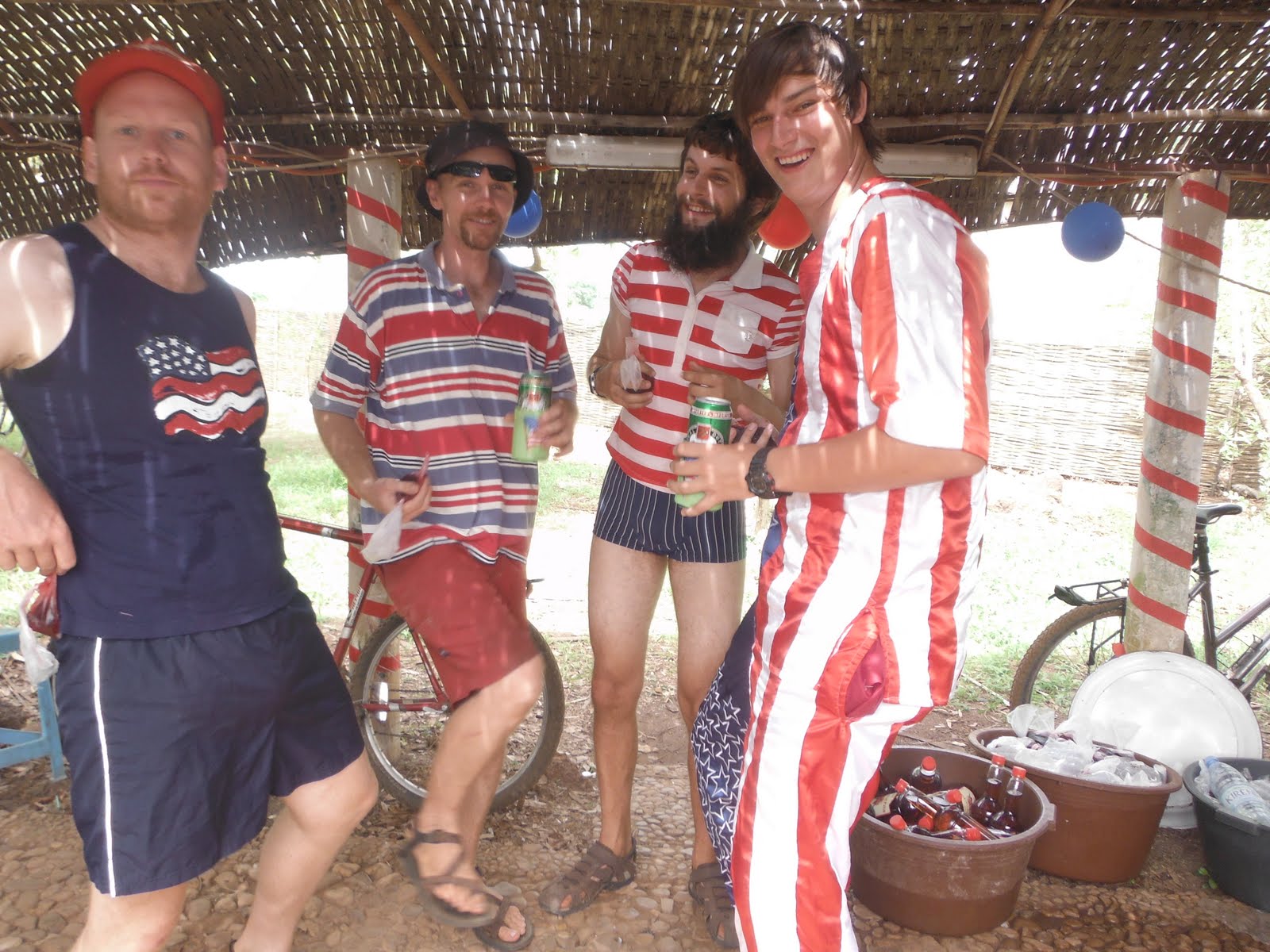
I never would have thought that the most epic Fourth of July party I will probably ever attend would take place in West Africa.  Peace Corps is full of surprises, and this was one of them.   Every year, Kedougou volunteers host an Independence Day extravaganza for the rest of the volunteers in Senegal.  Altogether there were about 170 Americans in Kedougou.  It was a bit overwhelming, but a lot of fun.  Everyone went all out with costumes (Senegalese and American-made), food, and even fireworks brought in special from Dakar.  My job was to make sure that we had ice to keep drinks cold, which entailed doing a tour of the neighborhood and asking everyone with freezers to put water in plastic bags and freeze so that we could buy it off of them on the fourth.  At one point, a woman said, “I’m going to come to your party and eat your fish and drink your tea.”  Although it might be hard for the Senegalese to comprehend this, for us, for one day only, fish and tea were the last thing on the agenda…

Pat getting festive with an American Flag haircut.  Imagine trying to explain that you want your hair to be shaved into an American flag to your Malinke host brother who also happens to be deaf.  Well that's what happened, which may explain the lack of stars.
Getting manly digging the pig-roasting hole...yep, that's right, a pig roast in Senegal.  For this purpose, it is fortunate that there is a small non-muslim population in this area of the country.

Butchering the pigs (5 of them!)

Not tea and fish...macaroni salad, cole slaw, and potato salad plus yummy dips!

Almost our entire training group reunited!  Here we are along the Gambia River

July 3: Heating things up for the slow roast


A sampling of costumes


Marie Christine, the housekeeper at the regional house, even got into the spirit!


When you request an American Flag outfit from a Senegalese tailor, beware, you might get stars of David

To appreciate this picture, you must understand the fukkijai.  These are clothing vendors that have received the unwanted clothes from American thrift stores.  It's amazing what cast off tshirts you will see very hip Senegalese wearing.  Chip was presented with this lovely festive get-up, with "Chipie" embroidered on it, straight from a fukkijai in Tambacounda.  Many costumes came from fukkijais or from the plethora of Obama gear that can be sold anywhere.  You name it, there is something sold in Senegal with Obama's picture on it.

Rainstorm dance party!


So glad that I can have access to a bicycle built for two in Senegal...especially a patriotic one!  (The Kedougou house now has a unicycle as well, built for the Fourth.)


Happy Fourth of July from the Gou Crew!  If we can throw this shindig here, imagine what can be done in actual America!

Sunday, July 15, 2012

The Wedding Drums are Pounding

It seems like every week there is some kind of ceremony going on in my site (trying to squeeze everything in before Ramadan), but a few weeks ago, our neighbor and friend, Fanta Damba, got married, and for the first time I didn’t feel like an awkward outside observer at the event.  Also, the day before the wedding, a package arrived from my parents bearing an Africa-proof (ie dust-proof and sand-proof) camera, so I was able to take advantage of my non-outsiderness and take pictures.  

Malinke weddings (and possibly Senegalese weddings within different ethnic groups—I still haven’t been here long enough to know whether things that I experience culturally are strictly Malinke or whether they are general West African phenomena) are three-day affairs, typically taking place on Wednesday, Thursday and Friday. There are still so many nuances of this culture that I know I am just starting to understand, so this account of the wedding is merely my own observations.  I still have a lot of learning to do about the why of these traditions.

In the book Poor Economics, the authors discuss the phenomenon that people in poor countries who do not have enough to eat will throw lavish parties.  They conclude, "We are often inclined to see the world of the poor as a land of missed opportunities and to wonder why they don't put these purchases on hold and invest in what would really make their lives better.  The poor, on the other hand, may well be more skeptical about supposed opportunities and the possibility of any radical change in their lives.  They often behave as if they think that any change that is significant enough to be worth sacrificing for will simply take too long.  This could explain why they focus on the here and now, on living their lives as pleasantly as possible, celebrating when the occasion demands it" (Banerjee and Duflo, 38).

Senegal calls itself the country of Teranga, or hospitality, and everyone is invited to weddings and baptisms.  (This is how I have found myself at multiple weddings and naming ceremonies when I have had no clue who was getting married or named).  

For this particular occasion for celebration, on the first day, Wednesday, a giant speaker system was brought in to the bride’s family’s compound.  The Senegalese like their music, and they like it loud.  They also don’t seem to mind continuous repetition of a select group of about seven songs, which played throughout the day at high, high noise levels.  Guests come and go, depending on their other obligations of the day, but it was made clear to Pat and I that we were expected to be a pretty constant presence.  There is dancing off and on during the day, mixed in with a lot of sitting around and drinking tea. 
Chilling under the shade tree around the tea set

 
Women spend a good part of the day doing serious hair braiding and food preparation.  Ceremony food is often a big step up from what we eat on a daily basis.  A big chunk of this is cutting onions, using hands as cutting boards (this is foreshadowing, FYI). 

Cooking fire in the cooking hut
About a week before the wedding, women come together for a "tugulo", or pounding party.  This either prepares food for the celebration of is used as a dowry or wedding gifts...so many things to still figure out!
Sisters-in-law preparing the food for the guests.  Practically every ingredient seems to get pounded at some point or another.
 
As night fell, a more steady influx of guests arrived.  Fanta emerged from her hut, flocked by her female friends wearing one of four matching outfits.  The amount of make-up she had on reminded me of the citizens of the Capitol in the Hunger Games.  The women walked in formation around the interior of the circle created by guests chairs and took unsmiling pictures.  I kept waiting for the groom to show up, since I hadn’t seen him yet…but he never did.  That is the most surprising thing to me about Malinke weddings, is that there is no element of public ceremony with the bride and groom together.
  
The bridal party

Sira, my counterpart, was part of the bridal party.  The women wearing her particular dress were mostly sisters-in-law of the bride
The bride in her night one outfit--this was my first time using my camera, so I hadn't figured out the night settings yet

After a delicious dinner of oily pasta and raisins, the speaker music cut out, and the women began drumming and chanting.  Two griots showed up with djembes around that time and began a process of djembe preparation that I never knew existed in all my summers listening to djembe at camp in Montana. 
Griots are the most visible caste in the Senegalese caste system.  They tell stories and provide music at ceremonies and often ask for money or other gifts.  At most weddings I have been to, bolts of fabric were given out…I thought the giving was at random, as I had received fabric for no particular reason.   Well it turns out that my toxoma (namesake) is not a griot per say, but she is a niamaxalo, which is the larger grouping of castes that the griots are a part of.  The Tiganas (her last name) are traditionally the metal working caste, but she does some griot-ish things like naming babies.  Apparently I have received fabric because, since I am my namesake in their interpretation of the namesake relationship, I am also a niamaxalo, and close enough to a griot to receive a special gift.  This was big news that I’m still trying to sort through.  I have also been given small amounts of money on several occasions, I think for the same reason.

One of the griot women getting the dancing going
Djembe preparation

After the Djembes were sufficiently warmed, a procession (not including the bride or groom), went to the dondula (place of dancing, which turned out to be the basketball courts) and danced until late in the night.  Since I am always exhausted and ready for bed at about 8:30, I did not stay long, but got rested for Thursday’s festivities. 

Thursday I went over to Fanta’s compound mid-morning.  She was preparing for the day by getting henna tattoos on her hands and feet, the only part of the bride that is shown when the guests show up in the afternoon.  I spent a lot of time during this whole process thinking back on the day of my own wedding and the preparations the morning of, and how very different it all is.


Wedding day preparations: when your face won't show, you have to make your hands and feet look really pretty

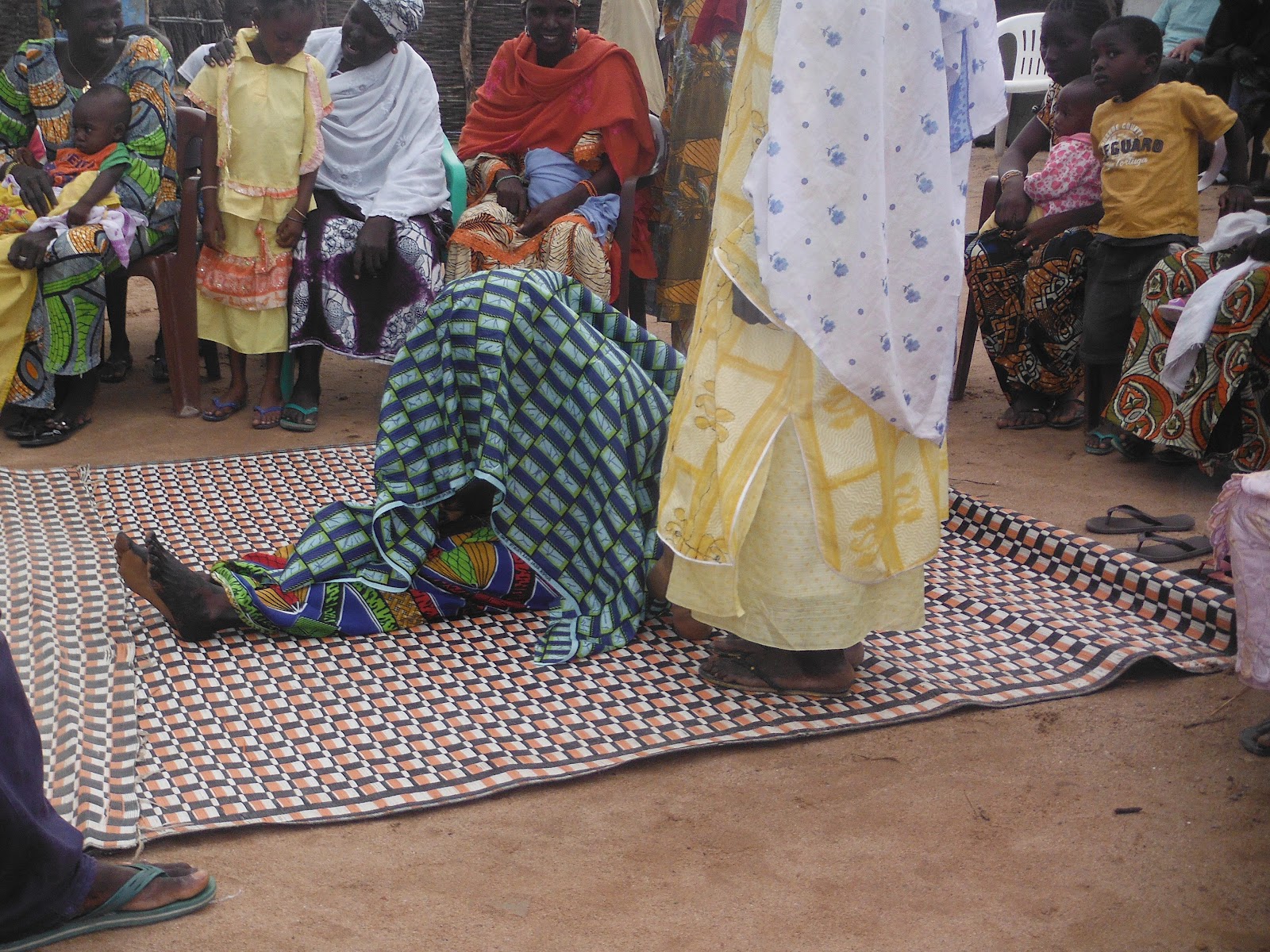
After lunch, someone said, “The sisters have arrived.”  I looked up to see a procession of women approaching the compound, singing and clapping.  Fanta went into her hut and was led out sometime later with a wax sheet covering her head.  She was laid down in the middle of the circle of dancing women.   Her feet were washed and her hair was braided while drums pounded, women danced, and the griots told the stories of the last name of her new husband (who was nowhere to be seen).


Dancing is quite the thing here.  I love watching women dance.  This video is of Sira, my community counterpart and best friend in site, dancing like a maniac.

I have discussed with fellow volunteers about how dancing is a powerful tool for integration.  People love you for putting yourself out there, and there is no verbal expression involved.  So whenever I’m asked to dance, I typically go for it full force, as you can see here:

After the dancing calms down, all of the gifts were brought out to be counted as everyone watched.  My host dad actually announced the counting of fabric, household goodies, and grain, and a griot would repeat everything he said.  Prior to the wedding, the bride’s family typically gives things like cola nuts, an animal, or money to the groom’s family to seal the deal.  
On the left is my host father, who would count the gifts.  On the right is the griot that would echo the number in a louder voice.
After the gifts were counted, a crowd gathered around Fanta to escort her to her groom’s house, where he was waiting for her.  As she was led away from her compound, her best friend was crying hysterically.  Upon marriage, women traditionally go and live in the husband’s family compound.  In this case however, her husband was living in a faraway city called Touba, and she would be leaving the next day.

The entourage of female guests plus Fanta's twin brother leading her to her new husband's home.  

The third day of the wedding is held at the groom’s family’s compound.  The men are more involved this day, and there are proclamations made and a goat slaughtered. 
 

As usual, I had my pocket knife with me and was ready to go when the carrots started getting chopped.  Most women think that I am incapable of doing the things they do (which is often true), so I’m always trying to prove myself.  Well I proved that cutting boards are necessary when you use a knife that’s actually sharp.  I sliced a chunk of my finger into the giant bowl of carrots and had to run home bleeding and humiliated.
All healed up now and I didn't even get a staff infection


The third day seems to be the most chill, however, so I don’t think I missed all that much.  Pat and I went back as Fanta and her two kids were loaded into the car with her new husband, headed to a new life in Touba.
I definitely think I wasn't supposed to be smiling in this picture.  Oops.  Habit.
I learned so much about this culture and community by being involved in this event.  However, another wedding was taking place right around this same time.  Kristi and Nick’s wedding was the first major event that I’ve missed due to Peace Corps, and there are already four other weddings that I know I’ll miss, which breaks my heart. 

 At least I made it to Washington in stick form.

Sunday, July 1, 2012

What if the Hokey Pokey really is what it's all about?


Growing up as the daughter of my high school’s yearbook advisor, one of my favorite times of the year was when the Seniors would turn in their glamorous photos and the words of wisdom they had selected to go with it.  I loved getting a sneak preview of what was to come and watching my mom roll her eyes at some of the more ridiculous senior quotes, debating whether to make them change it.  It’s funny what nuggets of childhood memory stick with you, but I remember being really tickled with one senior quote, which simply asked, “What if the hokey pokey really is what it’s all about?”  Well, based on an experience I had this week, I have decided that that just might be the case.

When looking at Senegalese and American cultural differences, one thing that stands out to me is the differing views of children.  While children are very much loved in both cultures, you might say that it is not expressed the same.  Respect for elders is very important in Senegal.  Barely anyone knows their numerical age, but everyone seems to know their relative age to each other.  This puts kids at the bottom of the totem pole.  Anything you don’t want to do, you can just have a kid do it.  I have often marveled at the nonchalance with which a mother will balance a baby on her back to strap him into the cloth.  It is the opposite of helicopter parenting.  Corporal punishment is common.  I have been told to hit kids that were bugging me and had to try to explain in limited Malinke that I just couldn’t.

Another thing is that adults don’t really play with kids.  (Well, I guess that’s a generalization, but in my three months here, I haven’t observed any intergenerational playing.)  There are eight kids in my host family’s compound, ranging from (I’m completely guessing here because they don’t know) about one and a half to about ten.  Besides my host father cuddling his two littlest granddaughters in the hammock, which is the sweetest thing in the world, the primary adult-child interaction in the compound is that of reprimanding.  Don't get me wrong, there is much love toward children, it's just not typically expressed through play.  Being someone who wants everyone to like me and lacking the language skills to immediately ensure that with the adults of the family, one of my first moves upon arriving was to try to get in with the kids.

The gang's all here: These are the middling age range of kids.  Khalifa, Jelemba, Samuro, Kounadi
Kounadi is crazy-excited about the camera that my parents sent in the mail
Getting my hair braided


 Getting in with the kids played out through several different strategies:


S1.  Singing American songs by request.  The most common requests are Shakira’s Waka Waka (known here as Tsaminamina) and Rhianna’s Rude Boy, which is so dirty that I feel super weird singing it to kids, but they love it and have no idea what I’m saying.

1


22. Duck, Duck, Goose.  I translated this classic into Malinke as Frog, Frog, Snake, since I have no idea how to say either duck or goose.  I actually think it might be more fun and exciting to get chased by a snake than by a goose.

33.      Hide and seek, a la Senegalaise.  The version of hide and seek that was taught to me by the kids involves everyone hiding together and yelling out when the group is ready to be found.  This is my least favorite game because it involves leaving the shade structure and venturing out in the hot, hot sun.

44.      Most recently, Hokey Pokey.  This has been a hit with the kids as well as the older students from surrounding villages. It has been good practice for reinforcing the vocabulary of body parts.


In the last few weeks I’ve actually had to do some learning regarding the setting of boundaries.  It turns out the kids like playing games so much that they come over to my house morning, noon and night hoping that I’ll play with them (also just watching us seems to be a fun activity).  Since I deal with a lot of “hut guilt” (feeling like I should be out integrating with the community at all hours of the day and feeling guilty for being in our hut), if I’m at my hut, it means I really need to be there, either to do work in peace or to get some rest.  When Pat was in Dakar, I had an emotional breakdown about feeling overwhelmed by the constant presence of a herd of kids at my hut and not knowing how to tell them they couldn’t come over and thus not knowing how to preserve my sanity.  Eventually, I just told them (in front of their grandparents and parents) that (literal translation here) their house was the place of playing and my house was the place of resting and working only.  This was actually quite effective, and I think the adults in my family had thought that this was a long time coming.  The kids still come over, but they understand the boundary and don’t get mad if I ask them to leave so I can get work done or rest. 
So we do a lot of playing at the Cissokho compound.  And lately I have even heard adults singing the hokey pokey in a hinting way as if to request it.  Then, a few days ago, something magical happened.  We were playing our afternoon round of Frog, Frog, Snake, and it was Alamuta’s turn.
Alamuta is the cutest.  She is captured here at one of the rare times she is wearing clothing.


Alamuta highly enjoys Frog, Frog, Snake, but she doesn’t really get it.  As she was walking around muttering and hitting about every third person on the head, Diounkounda, the mother of four of the kids, came over and took over from Alamuta.  Every single kid squealed around the circle squealed with the purest delight as Diounkounda ran from the snake she had chosen.  She was then chosen every time as the snake.  This was actually quite hilarious because she was breastfeeding Oumou who kept trying to hang on to her milk source for dear life as Diounkounda scampered around the circle of giggling kids.

Oumou trying to get in on the camera action as well

At Diounkounda’s request, we switched to Hokey Pokey, and sang and laughed until we ran out of body parts.  It was beautiful.  As we were walking back to our hut later in the afternoon, Pat said, “You know, we could leave tomorrow and feel good about our service after what happened today.”  I am in no way trying to paint myself as the patron saint of playing with kids or make any commentary on Senegalese parenting styles. (I am not a parent, despite the wishes of our entire for us to have a baby so they can give him or her a Senegalese baptism,  and I can only make these observations as a childless outsider who finds it easier to say “Frog, frog snake” than things you might say when conversing with adults.)  All I know is that, on that afternoon, the smiles of those kids and their mom made me wonder, “What if the Hokey Pokey really is what it’s all about?”